
Books/Creating Conversos: Difference between revisions
No edit summary |
No edit summary |
||
| Line 8: | Line 8: | ||
<h2>Creating Conversos: The Carvajal–Santa María Family in Early Modern Spain </h2> | <h2>Creating Conversos: The Carvajal–Santa María Family in Early Modern Spain </h2> | ||
<strong>By: Roger Louis Martinez- Davila</strong> | <strong>By: Roger Louis Martinez- Davila</strong> | ||
<p>In Creating Conversos, Roger Louis Martínez-Dávila skillfully unravels the complex story of Jews who converted to Catholicism in Spain between the fourteenth and sixteenth centuries, migrated to colonial Mexico and Bolivia during the conquest of the Americas, and assumed prominent church and government positions. Rather than acting as alienated and marginalized subjects, the conversos were able to craft new identities and strategies not just for survival but for prospering in the most adverse circumstances. Martínez-Dávila provides an extensive, elaborately detailed case study of the Carvajal–Santa María clan from its beginnings in late fourteenth-century Castile. By tracing the family ties and intermarriages of the Jewish rabbinic ha-Levi lineage of Burgos, Spain (which became the converso Santa María clan) with the Old Christian Carvajal line of Plasencia, Spain, Martínez-Dávila demonstrates the family's changing identity, and how the monolithic notions of ethnic and religious disposition were broken down by the group and negotiated anew as they transformed themselves from marginal into mainstream characters at the center of the economies of power in the world they inhabited.....</p> | <p>"In Creating Conversos, Roger Louis Martínez-Dávila skillfully unravels the complex story of Jews who converted to Catholicism in Spain between the fourteenth and sixteenth centuries, migrated to colonial Mexico and Bolivia during the conquest of the Americas, and assumed prominent church and government positions. Rather than acting as alienated and marginalized subjects, the conversos were able to craft new identities and strategies not just for survival but for prospering in the most adverse circumstances. Martínez-Dávila provides an extensive, elaborately detailed case study of the Carvajal–Santa María clan from its beginnings in late fourteenth-century Castile. By tracing the family ties and intermarriages of the Jewish rabbinic ha-Levi lineage of Burgos, Spain (which became the converso Santa María clan) with the Old Christian Carvajal line of Plasencia, Spain, Martínez-Dávila demonstrates the family's changing identity, and how the monolithic notions of ethnic and religious disposition were broken down by the group and negotiated anew as they transformed themselves from marginal into mainstream characters at the center of the economies of power in the world they inhabited....."</p> | ||
</div> | </div> | ||
<!-- BUY NOW button area (div3) --> | <!-- BUY NOW button area (div3) --> | ||
Latest revision as of 15:22, 3 January 2026
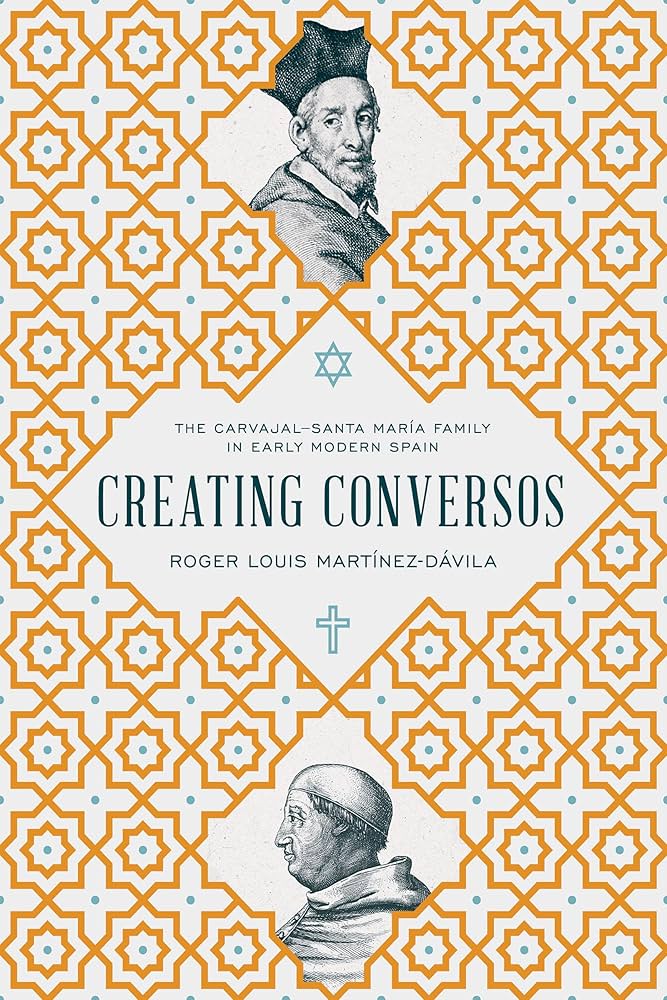

Creating Conversos: The Carvajal–Santa María Family in Early Modern Spain
By: Roger Louis Martinez- Davila
"In Creating Conversos, Roger Louis Martínez-Dávila skillfully unravels the complex story of Jews who converted to Catholicism in Spain between the fourteenth and sixteenth centuries, migrated to colonial Mexico and Bolivia during the conquest of the Americas, and assumed prominent church and government positions. Rather than acting as alienated and marginalized subjects, the conversos were able to craft new identities and strategies not just for survival but for prospering in the most adverse circumstances. Martínez-Dávila provides an extensive, elaborately detailed case study of the Carvajal–Santa María clan from its beginnings in late fourteenth-century Castile. By tracing the family ties and intermarriages of the Jewish rabbinic ha-Levi lineage of Burgos, Spain (which became the converso Santa María clan) with the Old Christian Carvajal line of Plasencia, Spain, Martínez-Dávila demonstrates the family's changing identity, and how the monolithic notions of ethnic and religious disposition were broken down by the group and negotiated anew as they transformed themselves from marginal into mainstream characters at the center of the economies of power in the world they inhabited....."